← All notesExhibit G · Filed 26 Jan 2026 · 8 min read
Server-Side Attack Techniques
Filed
Exhibit G — cover
Server Side Attacks
The infamous SSRF
Server-Side Request Forgery (SSRF) is a vulnerability where an attacker can manipulate a web application into sending unauthorized requests from the server. This vulnerability often occurs when an application makes HTTP requests to other servers based on user input. Successful exploitation of SSRF can enable an attacker to access internal systems, bypass firewalls, and retrieve sensitive information.
The infamous SSTI
Web applications can utilize templating engines and server-side templates to generate responses such as HTML content dynamically. This generation is often based on user input, enabling the web application to respond to user input dynamically. When an attacker can inject template code, a Server-Side Template Injection vulnerability can occur. SSTI can lead to various security risks, including data leakage and even full server compromise via remote code execution
The infamous SSI Injection(Server-Side Includes)
Similar to server-side templates, server-side includes (SSI) can be used to generate HTML responses dynamically. SSI directives instruct the webserver to include additional content dynamically. These directives are embedded into HTML files. For instance, SSI can be used to include content that is present in all HTML pages, such as headers or footers. When an attacker can inject commands into the SSI directives, Server-Side Includes (SSI) Injection can occur. SSI injection can lead to data leakage or even remote code execution.( Basically this kind of attack is identifiable with the extension of the html page, it would be something like .shtml and the code that is being ran by the server is commented inside)
XSLT Server-Side Injection
XSLT (Extensible Stylesheet Language Transformations) server-side injection is a vulnerability that arises when an attacker can manipulate XSLT transformations performed on the server. XSLT is a language used to transform XML documents into other formats, such as HTML, and is commonly employed in web applications to generate content dynamically. In the context of XSLT server-side injection, attackers exploit weaknesses in how XSLT transformations are handled, allowing them to inject and execute arbitrary code on the server.
Specificity of SSRF
This section will be more technical and we will get to know every server side attack on its own in depth
SSRF
INTRO
Server-Side Request Forgery (SSRF) is a critical web security vulnerability, recognized in the OWASP Top 10, that arises when an application makes a request to a remote resource using a user-supplied URL. An attacker can exploit this by manipulating the provided URL, compelling the server to initiate unintended requests to arbitrary internal or external services.This manipulation can lead to severe consequences. Attackers can leverage different URL schemes to escalate the attack:
http:// and https://: Used to scan the internal network, bypass firewalls, and access restricted administrative endpoints.
file://: Allows the attacker to read arbitrary files from the server's local file system.
gopher://: Enables sending custom data packets to other services, potentially facilitating attacks against internal databases or mail servers.
IDENTIFICATION
We can identify the vulnerability by capturing requests sent by the web app for an external service of some sorts, in our example, when the user chooses an appointment this is the request that gets sent to the web app, the server gets the date with dateserver POST parameter, and then send it in a post request to the index.php This is where we can find the vulnerability, if the user input isn’t sanitized we can make read source code and fully compromise the server in some cases.To determine whether the HTTP response reflects the SSRF response to us, let us point the web application to itself by providing the URL http://127.0.0.1/index.php:HTTP POST request to /index.php with date parameter; response includes DefendTech Innovations title.Since the response contains the web application's HTML code, the SSRF vulnerability is not blind, i.e., the response is displayed to us.Since the data is displayed back to us, we can enumerate the system, check for open ports, simply by fuzzing the http://localhost:FUZZ/ and the wordlist would be a list of ports that we want t investigate.
EXPLOTING
Accessing Restricted EndpointsWhen we identify such vulnerability, there is a range of things that we can do.In the example provided, we can run a brute force attack on the domain dateserver.htb, because in our case and many cases, such servers aren’t accessible to normal users and besides they may be internal to the server we are originally attacking.
Local File Inclusion (LFI)We can use this in many cases, especially if we have a vulnerability chain and we already know some internal file names that we can include.As seen a few sections ago, we can manipulate the URL scheme to provoke further unexpected behavior. Since the URL scheme is part of the URL supplied to the web application, let us attempt to read local files from the file system using the file:// URL scheme. We can achieve this by supplying the URL file:///etc/passwdThe gopher ProtocolTHIS IS CRAZY!Let’s set up the scenario for our example and everything will be clear after.As we have seen previously, we can use SSRF to access restricted internal endpoints. However, we are restricted to GET requests as there is no way to send a POST request with the http:// URL scheme. For instance, let us consider a different version of the previous web application. Assuming we identified the internal endpoint /admin.php just like before, however, this time the response looks like this:HTTP POST request to /index.php with date parameter; response shows Admin Dashboard login form.As we can see, the admin endpoint is protected by a login prompt. From the HTML form, we can deduce that we need to send a POST request to /admin.php containing the password in the adminpw POST parameter. However, there is no way to send this POST request using the http:// URL scheme.Instead, we can use the gopher URL scheme to send arbitrary bytes to a TCP socket. This protocol enables us to create a POST request by building the HTTP request ourselves.Let’s suppose that the admin password is weak.gopher://dateserver.htb:80/_POST%20/admin.php%20HTTP%2F1.1%0D%0AHost:%20dateserver.htb%0D%0AContent-Length:%2013%0D%0AContent-Type:%20application/x-www-form-urlencoded%0D%0A%0D%0Aadminpw%3DadminWhen we inject this payload into the dateserver parameter it returns the admin dashboard HTML code.The gopher protocol comes in handy when dealing with internal services over TCP, whatever the service may be HTTP;SSH..etc, but constructing payloads may be hard because it uses a special kind of syntax when it comes to URLs, we can use tools like Gopherus that will make the job easier.
Blind SSRF
INTRO
Blind ssrf occurs when the response isn’t displayed back to us, this kind of vulnerability has generally less impact due to severely restricted exploitation vectors
IDENTIFICATION
We can confirm the SSRF vulnerability just like we did before by supplying a URL to a system under our control and setting up a netcat listenerHowever, if we attempt to point the web application to itself, we can observe that the response does not contain the HTML response of the coerced request; instead, it simply lets us know that the date is unavailable. Therefore, this is a blind SSRF vulnerability:HTTP POST request to /index.php with date parameter; response indicates date is unavailable.This means that the accessed internal services or endpoints are dealt with server side and not displayed in the client side.
EXPLOITATION
Exploiting blind SSRF vulnerabilities is generally severely limited compared to non-blind SSRF vulnerabilities. However, depending on the web application's behavior, we might still be able to conduct a (restricted) local port scan of the system, provided the response differs for open and closed ports. In this case, the web application responds with Something went wrong! for closed ports:HTTP POST request to /index.php with date parameter; response indicates an error: 'Something went wrong!'However, if a port is open and responds with a valid HTTP response, we get a different error message:HTTP POST request to /index.php with date parameter; response indicates date is unavailable.There is always a way to make something out of an identified vulnerability,Depending on how the web application catches unexpected errors, we might be unable to identify running services that do not respond with valid HTTP responses. For instance, we are unable to identify the running MySQL service using this technique:HTTP POST request to /index.php with date parameter; response indicates an error: 'Something went wrong!'Furthermore, while we cannot read local files like before, we can use the same technique to identify existing files on the filesystem. That is because the error message is different for existing and non-existing files, just like it differs for open and closed ports:HTTP POST request to /index.php with date parameter; response indicates date is unavailable.For invalid files, the error message is different:HTTP POST request to /index.php with date parameter; response indicates an error: 'Something went wrong!'It all comes back to basic system enumeration, how the application catches and handles errors is the key to exploit this delicate vulnerability.To check for open ports we can use this ffuf command :ffuf -w ./ports.txt -u http://172.17.0.2/index.php -X POST -H "Content-Type: application/x-www-form-urlencoded" -d "dateserver=http://127.0.0.1:FUZZ/&date=2024-01-01" -fr "Failed to connect to"
Specificity of SSTI
Templating Engines
‘’’’’’’’’’’’
The "Cookie Cutter" Analogy 🍪
Imagine you have a cookie cutter (the template). The shape of the cutter—say, a star—is always the same. This is like your website's header, footer, and sidebar. They don't change from page to page.The cookie dough you use can have different ingredients (the data). One batch might be chocolate chip, another might be oatmeal raisin.‘’’’’’’’’’’’’’
INTRO
Template engines are safe when user input is treated as data to be placed into a template. However, Server-Side Template Injection (SSTI) vulnerabilities occur when an attacker's input is treated as part of the template itself, allowing them to execute code.
PS: the templating engine we will use for this section is Jinja
IDENTIFICATION
Identify SSTI by injecting special characters used in template engines and observing the application's behavior. Use this test string to provoke errors:${{<%[%'"}}%\.This will work on all the templating engines and it doesn’t mean for sure that the application is vulnerable to ssti, yet!
IDENTIFYING THE TEMPLATING ENGINE
Pretty clear picture I think no need to further explain.
EXPLOITATION( Jinja2 templating engine )
Jinja is a template engine commonly used in Python web frameworks such as Flask or Django. This section will focus on a Flask web application. The payloads in other web frameworks might thus be slightly different.Information DisclosureWe can exploit the SSTI vulnerability to obtain internal information about the web application, including configuration details and the web application's source code. For instance, we can obtain the web application's configuration using the following SSTI payload:
{{ config.items() }}
Since this payload dumps the entire web application configuration, including any used secret keys, we can prepare further attacks using the obtained information. We can also execute Python code to obtain information about the web application's source code. We can use the following SSTI payload to dump all available built-in functions:
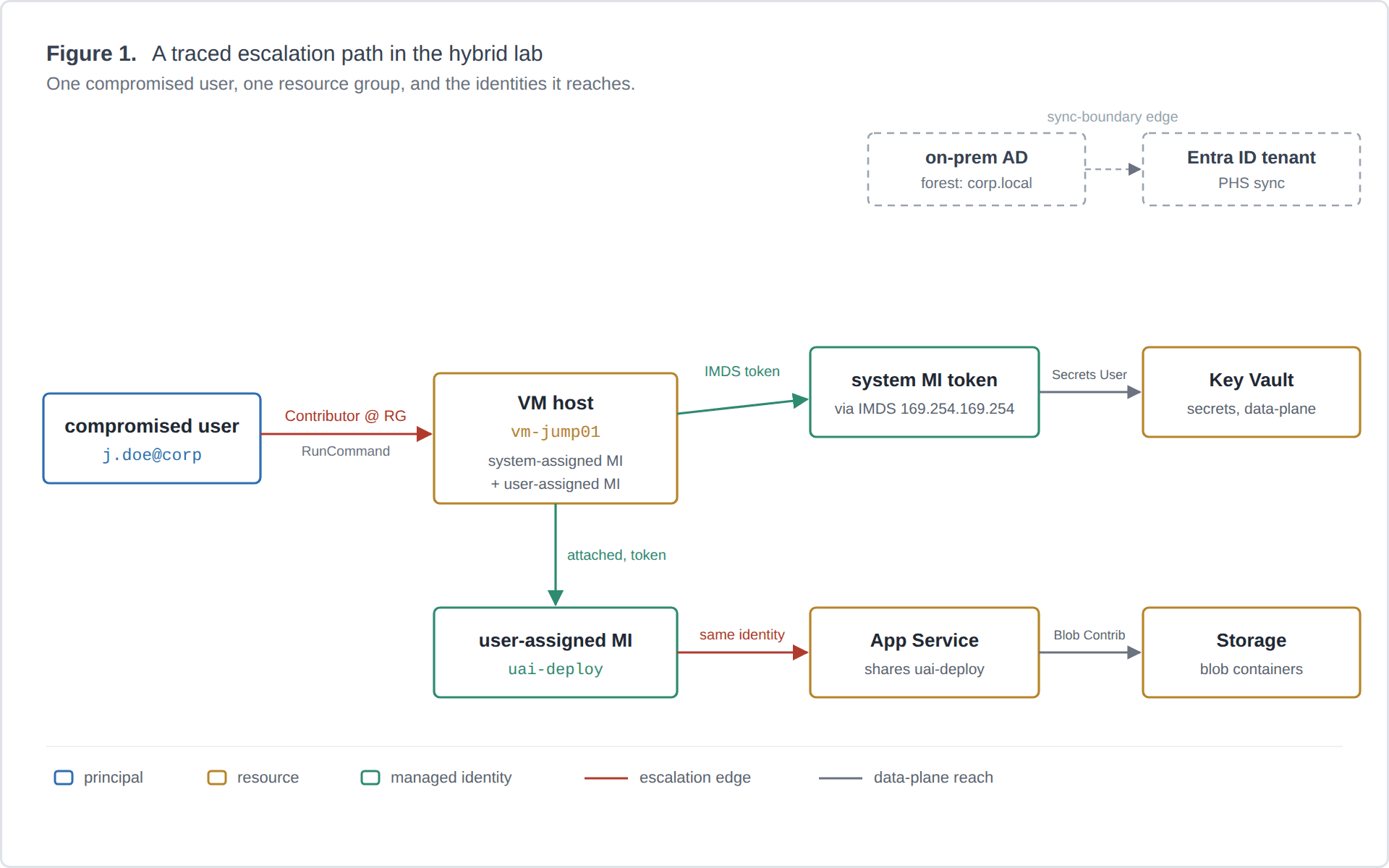
A framework for treating Azure managed-identity abuse in hybrid Entra ID environments as a graph-reachability problem. I define the node and edge types, ground each edge in Azure RBAC semantics, show how my tool Fenrir uses the model to answer one question conservatively, and work through a case study in my own lab. Framework and systematization, not an empirical study.
A walkthrough of Fenrir, a Python CLI I built during a red-team internship that automates the Azure identity attack chain: tenant recon, an exploit-readiness verdict, managed-identity token theft through compute hosts, and tenant-wide post-exploitation.